Discover the Power of Trial Frame Refraction for Low Vision
Do you feel like your vision isn’t as sharp as it used to be, even with new glasses? Have you had a standard eye exam but still struggle to see clearly? If you’re experiencing vision problems that don’t improve with regular glasses or contacts, you might have low vision—and a specialized trial frame refraction could help.
What Is Low Vision?
Low vision is a significant visual impairment that can’t be corrected with standard glasses, contacts, or surgery. It can make everyday tasks like reading, recognizing faces, or driving difficult—even if a recent eye exam said your prescription was “up to date.” Many people with conditions like macular degeneration, glaucoma, diabetic retinopathy, or optic nerve damage experience low vision.
But here’s the good news: a different type of eye exam can help you see better.
Why Standard Eye Exams May Not Be Enough
If you’ve ever had a typical eye exam, you’re probably familiar with the “Which is better—one or two?” test. This method works well for most people, but for those with low vision, it can be less effective.
That’s because traditional exams use a phoropter—a bulky machine that limits how naturally you view the world. If you have low vision, you may need a more precise and customized approach
to find the best prescription for your unique vision challenges.
Trial Frame Refraction: A More Accurate Way to Find Your Best Vision
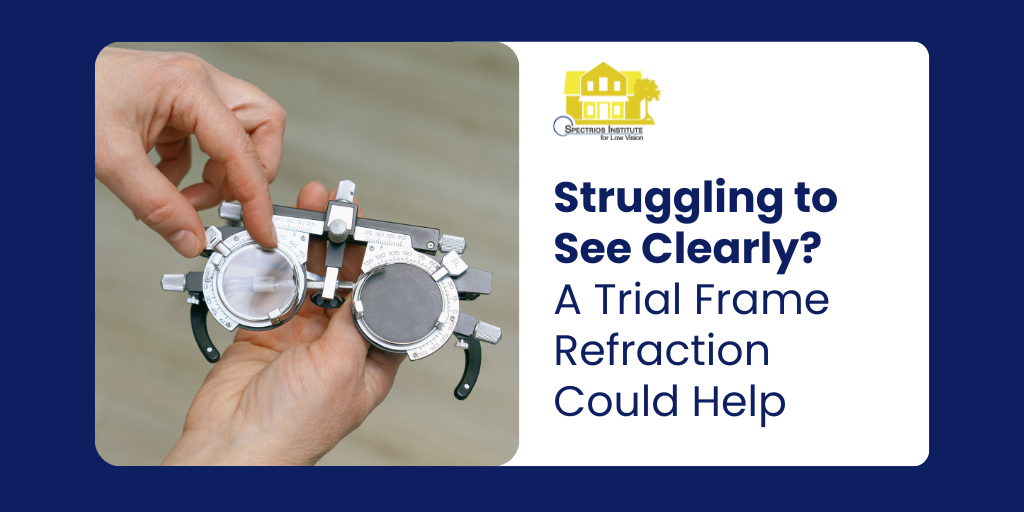
At Spectrios Institute for Low Vision, we use trial frame refraction—a specialized testing method designed for people with vision loss. Instead of using a machine, we place adjustable trial frames on your face. These frames hold different lenses, allowing you to experience how your prescription will work in a more real-life setting.
Why Trial Frame Refraction Works Better for Low Vision
✅ Feels More Natural – Unlike a phoropter, trial frames allow you to move your head, adjust your focus, and experience vision changes in a more realistic way.
✅ More Precise Prescription – The trial frame method measures the exact distance from your eye to the lens, which is especially important for strong prescriptions or complex vision conditions.
✅ Better Comparison of Lenses – You can quickly switch between lenses to determine which one truly enhances your sight, helping you get the best possible vision correction.
How a Low Vision Exam Can Improve Your Daily Life
A trial frame refraction is just one part of a Comprehensive Low Vision Rehabilitation process. With the right prescription and tools, you may experience:
✔️ Sharper vision for reading, watching TV, and recognizing faces
✔️ Less eye strain and fatigue
✔️ More confidence in daily activities like cooking, shopping, and using technology
Beyond glasses, a low vision specialist can also recommend magnifiers, telescopic glasses, electronic devices, or assistive technology to further enhance your sight.
Take the Next Step Toward Clearer Vision
If you’ve been struggling to see, even with your current glasses, don’t wait any longer. A specialized low vision exam could uncover new solutions to help you regain your independence.
At Spectrios Institute for Low Vision, you’ll be cared for by a nationally recognized team of low vision doctors and rehabilitation professionals with an outstanding track record for improving lives. Our comprehensive approach has even been cited by the National Eye Institute as a “Model for the Nation.”
We take time to understand your individual needs and goals—working closely with you and your family to create a personalized low vision rehabilitation plan. This includes a thorough low vision evaluation, follow-up care, occupational therapy, and hands-on training with assistive technology. From glasses and magnifiers to advanced tools and strategies, we’re here to help you live more independently and confidently.
📞 Call us today to schedule an appointment: 630-690-7115
📍 Visit us at: 219 E. Cole Ave., Wheaton, IL 60187
Article by:
Dr. Rachel Park, OD
Dr. Park is the Clinical Director at Spectrios Institute for Low Vision in Wheaton, IL. A graduate of the Illinois College of Optometry, she specializes in low vision care and is passionate about enhancing patient independence.