
Living With Retinitis Pigmentosa (RP): How Spectrios Low Vision Center Helped Beth Find Confidence and Independence
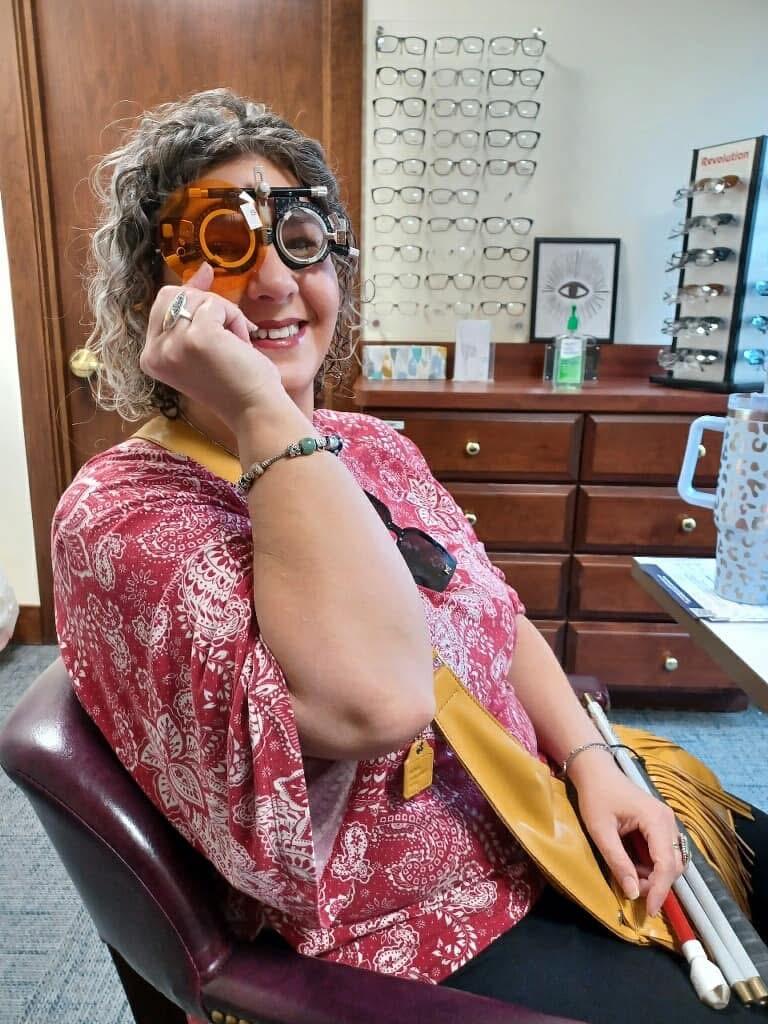
Beth V. believed she had perfect vision until a sudden change in 2018 led to a diagnosis of retinitis pigmentosa (RP), an inherited retinal disease. After years of adjusting, she turned to Spectrios Institute for Low Vision in Wheaton, where she found white cane and orientation and mobility training, access to BARD, ADA Paratransit information, special glasses and tools, and grants. She describes Dr. Williams as truly an advocate for his patients. Beth now feels at peace with her diagnosis and urges others with RP to find a low vision center near them and start there.
Retinitis pigmentosa is a group of eye disorders that are characterized by vision loss that worsens over time. These disorders affect the retina, which is the layer of light-sensitive tissue at the back of the eye
There was a time not too long ago when I bragged about my "perfect vision." Wow, how wrong I was! In the early fall of 2018, I was selling makeup and skincare (and later became a makeup artist for a short time). While doing an eye look in my private Facebook group, I suddenly couldn't do an eyeliner trick I had done so many times before. It happened overnight. I ended that video by saying I would post the picture afterward. I figured maybe I was just nervous being on a live stream.
At that time, my mom was still around, and I told her about it. She said not to panic. I was 40 now, and I probably just needed some glasses; this was a normal part of aging. I looked up who was in-network with my vision plan and scheduled an appointment. The doctor kept leaving the room, coming back, and asking me odd questions, like whether anyone in the family had pigment issues. I kept saying no. Finally, when she mentioned something about the retina, I panicked and asked if she thought I had diabetic retinopathy, because I had gained quite a bit of weight and my grandpa had diabetes. She quickly calmed me down and said, "No, nothing to do with diabetes, but I'm going to get you into this retina specialist by the end of the week. The thing is, what I suspect you have is so rare, I've never actually seen it in my practice."
I drove myself home that day a bit freaked out, but she never did say anything besides pigments, so I just waited until that Friday, when I saw the retina specialist. After some scans and visual testing, I finally saw the doctor. My dad went back with me, and the doctor said, "So who in the family is blind?" My dad and I glanced at each other quizzically, a bit confused, and both said, "No one." The physician insisted that someone on either the Italian or Irish side was in fact blind, even if we never knew about it, because what I had was genetic. He said something like, "I think you have something called retinitis pigmentosa, an inherited retinal disease, and it can and does lead to blindness. I need to send you to Rush Hospital for a test called an ERG to confirm, and we can do some genetic DNA testing as well. But I'm confident this is what we're dealing with."
He was shocked to find out I was not only still driving, but also driving at night. So as of that day in November 2018, I no longer drove at night. That alone was quite an adjustment to my lifestyle. He also strongly suggested I quit smoking, something I had taken up when I was 17.
A few months later, I got a phone call from a genetic counselor who went over the findings. It turned out they found 3 genes that I was a carrier for, but nothing definitively pointing to which gene was causing my RP. The hope was that in the next 10 to 15 years they could re-test me, because they are discovering new genes fairly quickly in this day and age.
I'm not going to lie, I was a bit freaked out that I was losing my eyesight, but suddenly so many things made sense. I was somewhat athletic growing up, playing softball my whole life, cheerleading, and even having a short stint in high school as a gymnast. So why, in the past 10 to 15 years, did I have some of the most preposterous situations? I tripped on a curb and got a spiral fracture. I stepped off a short stage and fractured my tibia. I bashed my head into an open window while heading upstairs that I apparently just did not "see." I even tried to play softball again in my thirties, and I used to be a really great left and center fielder, but now I was having trouble with my depth perception when going for the ball. Friends would often chuckle at how often I knocked drinks over while we were out, or fell into a bush (without alcohol involvement). It was all coming together. My physiatrist (pain doctor) had been thinking perhaps it was a proprioception issue, because why would anyone think it could be my eyes when I had "perfect vision"? Little did any of us know.
I spent the next several years pouring myself into my makeup business, getting certified as a makeup artist, and basically just adjusting to not being able to drive at night anymore. I was always the friend who would drive anyone, anywhere. I loved blaring my music and smoking my cigarettes. Now I would tell people I felt like Cinderella, and if I wasn't home before dark, I'd turn into a pumpkin! I didn't realize it then, but I was avoiding and distracting myself with food, cigarettes, and staying busy with my business.
In 2021, my mom passed away. Five months later, to the day, I quit smoking after 26 years. I gave myself one year to get that under control. My plan was to attack the weight the following year, which I started to do in August 2022. I spent most of 2023 working on eating right and working out a lot.
Then I happened to earn a trip to a leadership conference in Nashville for January 2024. It occurred to me, maybe in October, that I wasn't sure I would be able to navigate O'Hare airport very well without tripping or running into people and suitcases. I can still see very well, but not as well as someone without RP. I decided Spectrios made the most sense for me. I happen to live in Wheaton, so why try to go to Chicago Lighthouse for the Blind when I'm limited with my driving and have a low vision center right here in town? So I called, and Sylvia got me on the calendar for the following year, but she also connected me to Katrina, the OT. She said Katrina would hook me up with an O&M trainer for a white cane, so at least I could learn how to use one before my travels.
I think I only had one or two sessions total with Mike Tucci. We were walking in my driveway and near my home, and it was Mike who pointed out to me that I wasn't seeing as much as I thought I was. He was a bit horrified to find out I had planned on running to the grocery store in my car later that day. He put the fear of God in me that day, and I don't think I've driven again since then. I was successful on my trip to Nashville and back. It was shortly thereafter that I made the decision to always use my white cane when I leave the house. It's a tough decision to come to. But in my mind, I was no longer driving by choice, and this almost "graduated me" to the next level of this diagnosis. I will say that I heard you cannot get a guide dog unless you are proficient with the cane first (not sure if that's 100% true or not), but I figured, I love dogs, and I may need one someday in the future, so why not just do this now.
I finally had my appointment with Spectrios in March or April 2024. I was a bit nervous, excited, apprehensive, you name it. Let's just say it was the best decision I've made in this entire journey. I frequently comment on posts in an RP support group to other members across the world, asking them to please find a low vision center near them and start there. It truly makes a world of difference.
Dr. Williams reminds me so much of Mr. Rogers, I don't know who else to compare him to. He puts your mind at ease, encourages you, cheers you on, and is truly an advocate for his patients. My friend recently accompanied me to my annual appointment, and I was bummed she wasn't going to get to meet him because this was with OT. Then he suddenly made an appearance, and I was thrilled that one of my close friends got to meet him! She even exclaimed, "It's not often a friend is excited for you to go to the doctor with them, and now I see why!"
Going to Spectrios has given me so much more confidence in myself with this condition. My life isn't over; it's just taken a massive detour, and they're helping me figure out how to navigate it. They provide tools and resources I didn't even know existed, such as the white cane and trainers, access to BARD (a library resource for low vision and disabled readers), ADA Paratransit services through RTA, and special glasses and tools like OTT Lights. For when I get worse, there are so many more tools and resources available. They also have grants available, which is very helpful when you're not working or not making much money.
I recently decided to apply for a traditional job for the first time in about a decade, and they have been nothing short of excited for me and encouraging. They offered to speak to the HR department if needed and to help with any tools I may need. We are even getting me a pair of Transitions (trifocals) so I can be ready for this job, or any others.
I'm finally feeling at peace with this diagnosis, and I know that's mostly thanks to God and Spectrios. I'll close with this: in the movie Shawshank Redemption, there's a line that really resonates with me now, "Get busy living, or get busy dying." When you finally decide to go to Spectrios, you are choosing to start living your new life with your visual impairment or blindness. And it's an exciting ride
Help Us Keep Stories Like This Possible
Every story of independence, hope, and renewed confidence starts with access to specialized low vision care — and none of it would be possible without the support of our community. Through the Vital Vision campaign, you can help ensure that adults and children facing vision loss have the resources, technology, and expert care they need to keep living the lives they love.Your support helps fund comprehensive low vision exams, occupational therapy, assistive technology training, and so much more — the very services that made stories like this one possible.